
Disclosure: this article contains affiliate links. If you buy through them, AliCoinsDeals may earn a commission at no extra cost to you.
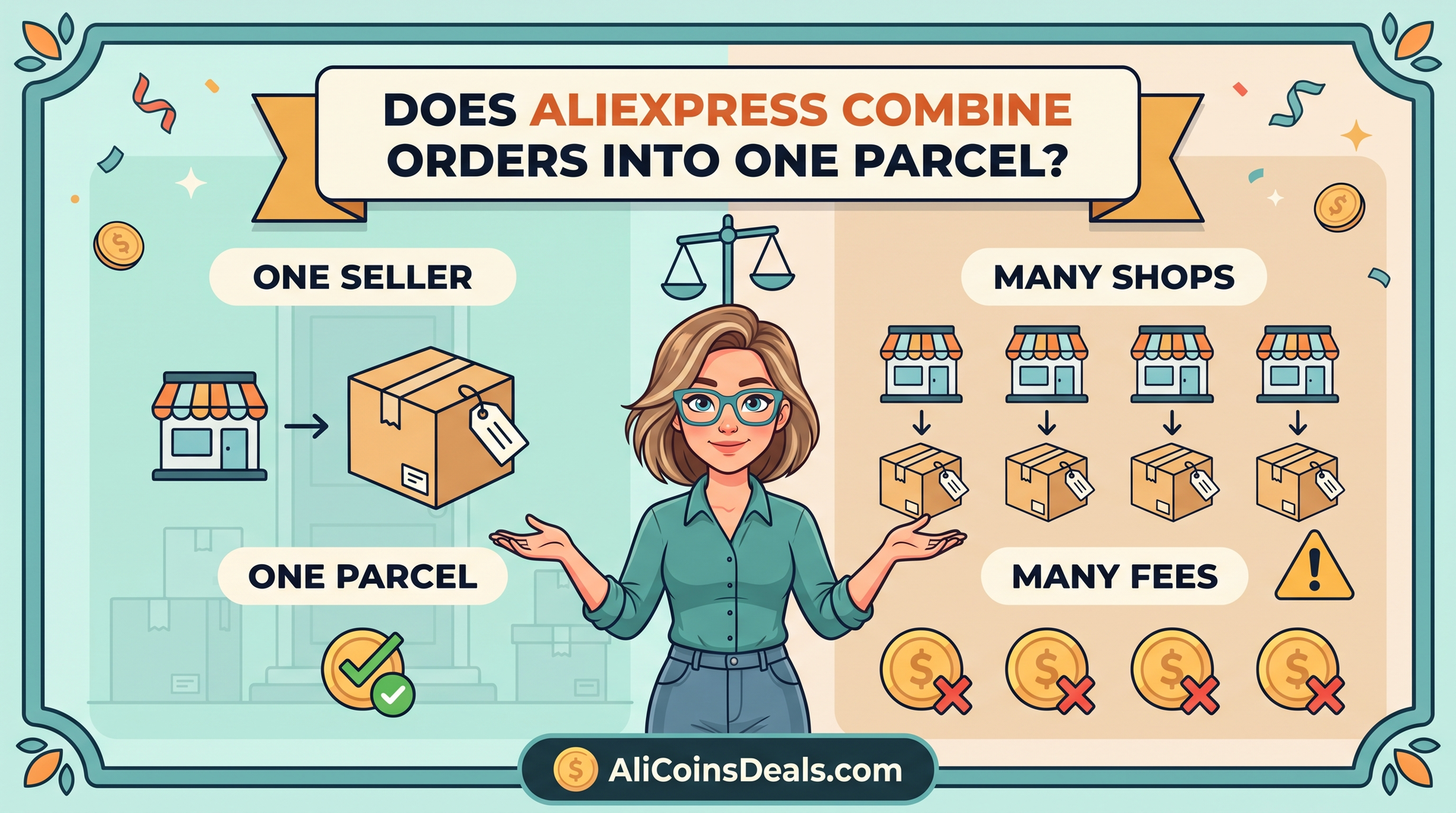
Only within limits. AliExpress consolidates parcels inside its own managed Choice pipeline, and it does not merge orders across independent sellers. If you buy from four different shops, four parcels are shipped, four times, however they were paid for.
That used to be a mild annoyance about doorstep clutter. Since the EU began charging duty per product type in July 2026, and added a €2 handling fee per line in November, the number of different products and parcels in an order has a direct effect on what you pay, so consolidation went from convenience to arithmetic.
Key Takeaways
- Consolidation happens inside Choice, per seller, not across the whole marketplace. Different shops always mean different parcels.
- Cheap shipping on non-Choice listings is priced per seller and per method, which is why identical items quote wildly different amounts.
- Buying more items from one seller is the single most effective way to reduce both parcels and charges.
- The EU’s €3 duty and €2 fee count product types in each parcel, so many different tiny purchases cost more, and identical units split across parcels pay once per parcel.
- Each parcel is a separate delivery risk and a separate claim, so fewer parcels also means fewer things to chase.
Does AliExpress Still Combine Orders Into One Parcel?
Inside Choice, often yes. Choice runs on AliExpress-managed logistics, so multiple Choice items bought together are frequently shipped as one consolidated parcel with one tracking number. That is one of the programme’s genuine advantages, and it is explained in what is AliExpress Choice.
Outside Choice, no. Each independent seller arranges its own shipping with its own carrier from its own warehouse. There is no mechanism for the platform to gather parcels from unrelated shops into one shipment, so an order spanning several sellers becomes several shipments automatically.
Within a single seller you sometimes get lucky. Buy three items from one shop and many will pack them together, because it is cheaper for them too. It is not guaranteed, it is not shown at checkout, and asking the seller in advance is the only way to know.
Why Do Two Identical Items Quote Different Shipping?
Because shipping is priced by the seller, not by the platform. The same product from two shops can carry different costs because each seller picks a different carrier, a different service level and a different amount of subsidy.
Four things move that number. The dispatch warehouse, since local or regional stock ships cheaper than a parcel from China. The weight and volume, since bulky low-value goods are the worst case. The service tier, from untracked economy to tracked express. And the seller’s own pricing choice, because some absorb shipping into the item price and advertise it as free.
So compare the delivered total, never the item price. A listing at a slightly higher price with free shipping regularly beats a cheaper one with a fee attached, and the ranking changes again once duty is added at checkout.
Why Did Your One Order Arrive as Several Parcels?
Because “one order” on AliExpress is a payment, not a shipment. The platform groups your basket for billing and then splits it by seller and by warehouse for fulfilment, which is why a single confirmation email can produce four tracking numbers over three weeks.
Even one seller can split an order. Items held in different warehouses, or a mix of Choice and non-Choice stock, cannot travel together, and a seller will usually ship what is in stock rather than hold everything for one slow line item.
The practical consequence is about claims, not convenience. Each parcel has its own tracking, its own delivery window and its own dispute, so a five-parcel order is five separate things that can go wrong. If one goes quiet, the guidance in AliExpress tracking statuses explained applies to that parcel alone.
Does Consolidation Save You Money on Duty?
It saves you money on the charges that attach per parcel, and much less on the ones that attach per product type. That distinction is the whole game now, and it is worth being precise about.
Since 1 July 2026 the EU applies a flat duty per item on low-value imports rather than per parcel (European Commission, 2026). An item here means each product type in the parcel, so combining ten different goods into one box does not reduce the count. Identical units are the exception: in one parcel they share a line and pay once, while split across parcels they pay once per parcel. The €2 EU handling fee that started on 1 November 2026 counts the same way, per declaration line (Dutch Customs, 2026). Who pays both, and how they reach your total, is in the new EU import customs rules.
What does help is buying fewer different things instead of many tiny ones, keeping identical units in one parcel, and paying one shipping fee instead of six. A courier’s own clearance charge, where one applies, is per parcel rather than per product type. The full charge picture is in AliExpress import tax and customs fees by country.
How Do You Actually Get Fewer Parcels?
- Filter to one seller and fill your basket there, rather than buying the cheapest version of each item from a different shop.
- Prefer Choice listings when you are buying several small things, because Choice is where consolidation actually happens.
- Check the dispatch location on each listing and group items that ship from the same place.
- Message the seller before paying and ask them to pack the items together. Many will.
- Reach the free-shipping threshold in one basket instead of splitting it across two orders that each pay postage.
- Avoid mixing Choice and non-Choice items when you want a single delivery, because they cannot travel together.
None of this is exotic, and it now pays twice: less postage, and fewer per-parcel charges on top.
Frequently Asked Questions
Can I ask AliExpress to hold my items and ship them together?
Not as a platform feature. Consolidation inside Choice is automatic when it applies, and outside Choice it is entirely the individual seller’s decision. Ask the seller directly before you pay, because after dispatch nothing can be combined.
Why is shipping more expensive than the item itself?
Usually weight and volume. International carriage is priced on size and mass rather than value, so a cheap bulky item is the worst possible thing to ship a long distance. On those goods, a local seller with regional stock is frequently cheaper overall.
Did AliExpress remove free shipping on non-Choice items?
Free shipping on regular listings was always set per seller and per country rather than guaranteed, and it varies with promotional periods. Check the shipping line on each listing rather than assuming a threshold you remember from a previous order.
Is one big parcel riskier than several small ones?
It concentrates the risk rather than increasing it. One parcel is one thing to track and one claim to file, which is simpler. If it goes missing you lose more at once, so on a high-value basket the tracked service is worth the extra cost.
Do multiple parcels mean multiple duty charges?
Per-parcel charges such as a courier’s clearance fee, yes. The EU’s €3 duty and €2 fee count product types per parcel, so different goods pay wherever they’re packed, but identical units split across parcels pay once per parcel (European Commission, 2026). Keeping identical items in one order and one parcel is the tactic that actually reduces it.
AliExpress consolidates inside Choice and inside a single seller’s warehouse, and nowhere else. Treat every seller in your basket as a separate shipment with its own cost, its own delivery window and its own claim, then build the basket to minimise how many of those you create. Since the EU duty and fee now count product types in each parcel, buying fewer different things from fewer shops, with identical units kept together, is the habit that keeps the final total closest to the sticker price.
Check where your parcel really is
Paste your tracking number into our free tracker to see which carrier has your parcel and what its latest status means.